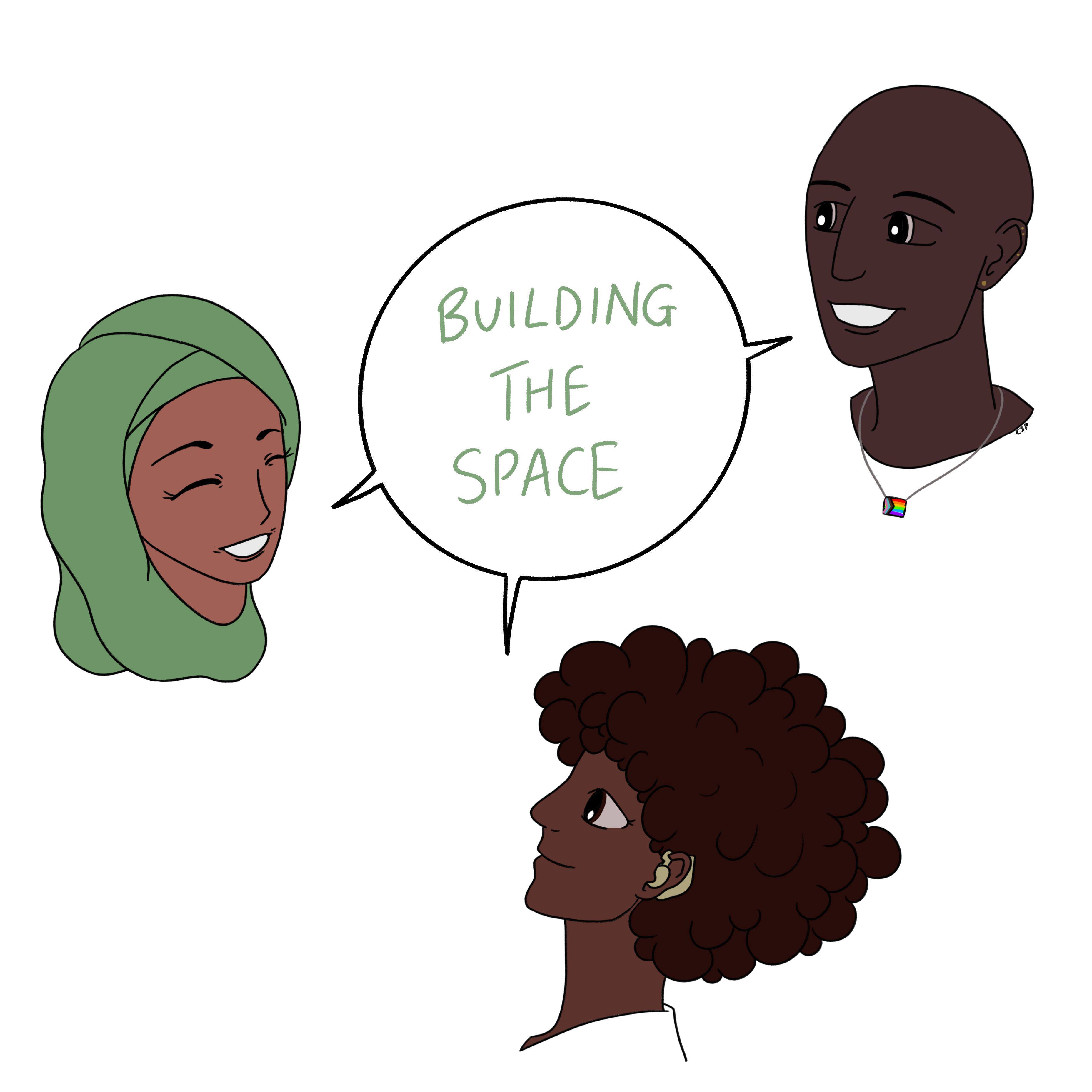
Hameed talks about suicide prevention and the importance of ensuring that racialised communities are included in conversations about mental health, wellbeing and support. Drawing on his experiences and insights, he reflects on the barriers some people face when seeking help, the importance of culturally responsive approaches, and why communities must play a central role in shaping solutions. This conversation forms part of Building the Space: Amplifying Racialised Voices in Suicide Prevention, a campaign dedicated to sharing lived experiences, building understanding and influencing change.
About the Campaign
Building the Space: Amplifying Racialised Voices in Suicide Prevention is a year-long campaign led by Isaac Samuels that seeks to amplify lived experiences of suicidality, suicide prevention and bereavement within racialised communities.
The campaign has been created in response to the ongoing absence of racialised voices within many conversations about suicide prevention, mental health, research, policy and service design.
Through lived experience storytelling, community dialogue and collective learning, Building the Space aims to create opportunities for people to share their experiences safely and on their own terms. These stories will contribute to a growing body of community-led evidence that can help shape future policy, practice, research and support.
At the heart of the campaign is a simple belief:
The people closest to the issues are often closest to the solutions.
Over the coming year, the campaign will share stories, host conversations, build partnerships and create opportunities for communities, organisations, researchers and policymakers to learn together.
How You Can Get Involved
There are many ways to be part of Building the Space:
• Share the campaign through your networks.
• Watch and share campaign films and stories.
• Follow the campaign throughout the year.
• Share your own lived experience where it feels safe to do so.
• Become a campaign partner, supporter or collaborator.
• Connect us with organisations, researchers, policymakers and community leaders.
• Host conversations and create opportunities for learning and reflection.
• Help amplify racialised voices in suicide prevention.
Learn more about the campaign:
https://communityreporter.net/building-space
Register your interest and get involved:
https://docs.google.com/forms/d/e/1FAIpQLSfcBJRcSA8kLw8fvB9_PyyzS4bsFP9Z0rppkWHr8f_D1OCATA/viewform
Support and Resources
If you have been affected by any of the issues discussed through this campaign, please remember that support is available. Reaching out for help is a sign of strength.
Immediate Support
Samaritans
Call 116 123 (free, 24 hours a day)
Website: https://www.samaritans.org
Shout
Text SHOUT to 85258 for free, confidential text support 24/7.
Website: https://giveusashout.org
Mental Health Support
Mind
Website: https://www.mind.org.uk
SANEline
Call 0300 304 7000 (4.30pm to 10.30pm daily)
Website: https://www.sane.org.uk
Suicide Prevention Support
Campaign Against Living Miserably (CALM)
Call 0800 58 58 58
Website: https://www.thecalmzone.net
Bereavement Support
Bereavement by Suicide Support
Website: https://uksobs.org
Cruse Bereavement Support
Call 0808 808 1677
Website: https://www.cruse.org.uk
If you are in immediate danger or feel unable to keep yourself safe, call 999 or attend your nearest Accident and Emergency department.
You do not have to face this alone.
Transcript
This compute Um, so let me just double check something, um. Now speak Hello. Cool. Can I just double check that you're OK with the consent and everything and you're happy to participate in this conversation? Yes, I am.
So Hamid, you and I, we go back, I think it's about 15 years, you know. And um thank you for finding the time to come and speak with me. I'm trying to uh be brave and start this campaign on a topic that you and I have spoken about many times over the years, we've known each other.
So can I get you to introduce yourself and tell me a little bit about yourself? Well, I am Hamid Khan, and I'm a British Pakistani Muslim male, um living in the United Kingdom, predominantly lived in Birmingham and Manchester, and have travelled different countries and lived in a couple of different cities at short periods, and that has really made me realise that. The level of inequalities, discrimination, and racism that still exists in certain parts of the country or in communities or sometimes even the institutional racism that has an impact on us. It's really profound and I'm just wondering how this then relates to the experiences of suicide.
Prevention, so as a racialized person, do you feel that your experiences around mental health, um or suicide have been properly understood by people around you or services? I think that first of all, for many years, suicide has always been a very taboo subject and a very subject that doesn't get talked very often, and usually people only talk about it when somebody's actually have been, have taken their life or ended their life, and then it gets something that is seen as a tragedy. And there's twofold to it. Either it's like seen as, oh my goodness, or why did they do it, you know, where they're a weak person, it's almost like they blame the person who's taken their life.
There's that element of it. Then there's also the racism impact of where people make assumptions that you must have. Done something wrong, you must have been hiding from something, and you saw taking your own life as a way out, so that can cause a lot of pressure, enormous pressure on on individuals who probably have acted out.
I can only talk for myself, but you know, when I've acted out and not been successful in, in, in, in taking my life, um, and I've had two very, very horrific experiences in my lifetime where I've tried to take my life due to, Societal pressure due to uh uh victimisation, racism, and everything just plays your mind when you're at the stage where you just, especially when you have I I suffer from bipolar disorder and anxiety and depression caused by social um environments that I've been involved in. As in sometimes living in areas which have not felt very safe for me or being around people that have been very blatant by being racist, um, and I think that that has an impact on how you see, um, the way that, People perceive people who take their lives, and I think first of all I'd like to really emphasise is that, even today as we speak, people still say so and so committed suicide. Now, that it was a criminal offence, you know, many, many years ago to take your own life, and it's still you've got to get feel like you're a criminal, if somebody's taken their life, it's like they've committed a crime and they haven't.
So that's something that also saddens me. And I think the last thing I'd like to say is that I've been quite fortunate that I've been able to explore a bit deeper by getting involved with a few different projects with different organisations around looking at suicide. One of the projects I was involved was looking at people who take their lives, you know, in high risk public spaces like the bridge, the highway, the motorways, the rail tracks, and I've become very deeply saddened that.
Humans are very, very fragile, particularly men, because men don't talk that often, and they'll act out, and then usually end up being successful where their life has ended, and we have some very good examples of Heath Ledger, who was an actor, he was an amazing actor, life was great, and he took his own life and nobody knows what was the deep reason why he took his life, because on the surface, he was quite a successful. In his life as an actor, we know about is it Robin Williams, another actor who was the night the day before was very jolly, very happy, you know, coming across as being very positive, and next day he took his life. All this does play a role in terms of uh men, particularly from racialized communities that we don't hear very often.
Because sometimes they may not be a celebrity, so we don't hear it very often. I was shocked that almost every day somebody takes their life on a rail track, but because it's so common that we don't really, we don't very, it's very rare we hear about it on the news, so they'll just say, uh, rail track, I've been on trains where they'll say, sorry, some engineering reasons, there's a delay for 2 hours, or there's a cancellation. But actually when I scratched the surface, it was because someone's taken their life on the bridge and that track's been closed down, but they don't even share that with you anymore, you know, so I think that, We need to really kind of speak about, you know, people taking their lives and what we can do, particularly for racialized men and women.
Because you know Islamophobia is very high, usually people who have got a faith of Islam may come from a racialized community. We know racism is on the increase with now that the way that the far right are, you know, uh, playing out so many different things, and one of the things I want to share that sometimes it can have an impact on you, like for example, if you look at. The way that they're publicising Pakistani grooming gangs, now I'm totally against any form of grooming gangs, and I absolutely, 100%, you know, are totally against it, but when you're a Pakistani male, you feel like that you're being seen as a perpetrator, you're being seen in the same category, you're being seen and judged in the same way.
And that can have a big impact on you, where you start to feel as though you need to justify to the world that you're a good person and you're not one of them or you don't think like one of them, and that can also make you feel quite sometimes have an impact on the way you think about life. And suicidal thoughts is, you know, a mind is very fragile, you know, su suicide ideation, thoughts, and then acting out and then being sick, so there's 4 stages to it. So I think sometimes, you know, I've had suicide ideation but never discussed it with anyone.
I've had suicidal thoughts and I've never discussed it with anyone. I've um actually acted out. And wasn't successful and didn't actually get to speak about what actually has happened to anyone or I've been twice in my life in a scenario where I've actually acted out, not been successful, and end up in a mental health inpatient setting because of trying to take my life, and it's like you have to be at stage 4 even to get any services or to be even acknowledged or noticed that you're trying to end your life, and I just think there's a lot of suffering in silence.
Hm. So, so can I ask you, and I'm so grateful you're so still here because you've really added a lot to my life over the Thank you. Thank you so much.
We've known each other. There's some people carry things in silence, um, as you said, um, because they feel misunderstood or judged. Um, and that racial element, do you think there's any misunderstanding or judgments that come from experiencing feelings of suicidality, feeling like you want to end your life because you're a racialized person? I think I want to say something very openly.
This is a third party experience I want to share. Now, I, I live in Birmingham and I have a lot of African Caribbean friends, and when we had the Windrush scandal where people who had been here for 50 years, 30 years, 40 years, and suddenly they said, oh, you don't have a passport, you don't have citizenship, you need to leave this country. Now, some of these, you know, people I knew had come to this country when they were 3 years old, 2 years old, 4 years old, 5 years old, 10 years, they were child-based and somehow they slipped the net where they've not been able to get the right document or been able to apply, and the amount of stress and the pressure they were under, some of them actually said to me very oddly that they wanted to end their life because, You've been living here for 40 odd years and we've said, oh this is not your home, this is not your country, and this is the only country you know.
You know, the unsettlement of the racism that played a part in that, uh, people start to feel like taking their own life was better than being deported. So that's one section of the community I just shared an example of from the African Caribbean community, particularly the Caribbean from Jamaican community, few people I know who shared that with me very openly. I think also in the Pakistani community there's been a lot of people where they've come to this country because somebody's brought them over through marriage and then treated them really badly and it's almost like they've got this constant pressure on their head that they're going to be deported at no fault of their own just because somebody doesn't want them here and they don't know how the process works to apply to stay here.
That's caused and it's been usually. The men have felt. Id racism where because you're a male, you must be the problem in the marriage, you must have been the issue, you don't, you're not, and it's almost like they've been treated very harshly and some of them like are waiting 4 years, 5 years, and they still don't have a decision whether they can stay in this country for good, will they be able to stay here because it's still the cases are up in the air at Home Office and that causes a lot of um.
Additional pressure. Then I want to touch upon a final community that I've come across is the refugee and asylum seekers who have come into this country. Some of them are genuinely are, and there's no doubt in that, that they identify with the LGBT community.
They've applied for asylum because in their country it's against the law to be who they are, their lives at risk, and it's almost like. They are not being believed, and they're being judged, it's like they need to prove they are, and how do you prove your sexuality, you know, it's like what they want to see as evidence, you know, you know, I'm being a bit um sinister here, but you know, what do they want someone to be, You know, how do you, you know, and they've just felt this enormous pressure all the time of just feeling very unsettled, where not being believed that in their country's against the law and their life is at risk. That causes people to feel very suicidal or it's almost like if I'm going to go back and they deport me and I'm going to live a life in fear, I might as well end my life here, at least I'll die here with dignity rather than going back and being named and shamed and then also my life being at risk.
So these are the kind of small examples of racism I've seen in the system. Yeah, and you just take, you took me to this place of when I reached out and you know me, you know my approach is very much er a human to human connection connection and that systemic racism that you're talking about really made me think about er a couple of people um who want to share their stories and we're trying to figure out how to share their stories because of the fear of um being further shamed. But they had really been um suicidal as a result of the scandal with um the post office um and how disproportionately their experiences, their words were that they experienced harsher treatment because they were South Asian than other groups of people that were caught up in that scandal.
So these, Things really do affect the way that we see ourselves and how we are able to manage. So thinking about everything you've said, um, have there been times where racism, discrimination, or not feeling like you. Belong, have affected your mental wellbeing and or made it harder to reach out for support.
I think you know it does because I think first of all, we don't know where the services are, you know, it's very rare you hear about services that are available for people who have, uh, particularly when it's mental health, social circumstances, and suicidal ideations. I think that's the first thing. The second thing is that Samaritans, you always assume it's for people.
Uh, it, it comes across that you have to be in crisis, but sometimes people may not see themselves in crisis, but they're feeling very, you know, and sometimes people are so distressed, so. Over the. Overwhelmed with so much going on in their mind that they just find comfort and ease and thinking ending my life is the only way to get comfort and ease.
And that sense of, oh, it's going to be over, and I think that's why no matter how hard life is, we need to get some messages out there and services out there to people about. Um, that. There's always a way, a solution, or there's always a way that somehow.
The only option isn't and should and should not be even considered ending your life. There is other support, and that's why we need to share more support services so people know that other people have been in that situation and access the right services and are OK, Jake. I think the problem is that when you have, when you're in that situation, you think you're the first person in this world to feel that to and.
There's no way out, and I think we need more awareness on that suicidal thoughts, suicidal ideation, ending your life is OK. Most people, some people have those thoughts. What's not OK is acting it out and taking your life.
That is not the solution, and Things can be uh better by reaching out for the right support services. Mhm. Do you think that the current support services, the current um campaigns, publicity reflect people like us? I think they don't.
I think usually I've noticed when I've come across suicidal ideations, literature, or about people taking their lives or anything, it's usually very seen as a very, usually you find people of mainstream white communities. Kind of on these kind of literature or paper, and yes, I don't see that it's very rare, and I think we need more of it's cultural sensitive, cultural pacific, uh and also in tying in faith and religion, because in some religion, you know, committing suicide uh taking your own life, I don't want to use the word committing suicide, but taking your own life is seen as a sin. And sometimes people can be very black and white in the way they say it, but actually, um, there's also mercy, love, kindness, and it's actually there's more ownership on the community to look out for each other and support each other.
So if somebody's going to a church or a mosque or a gurdwara or a temple and saying I'm feeling very suicidal, I want to end my life, we know that those who understand the faith. Properly will have mercy, compassion, kindness, support the person, you know, put them on observation, check up on them, but sometimes they've not had that kind of awareness, they might just say, oh, but that's a sin, how can you think like that, that's against the law of God, you know, it goes against the Bible, it goes against the Quran, and that can make people feel very, very, um, Disassociated with their faith or disassociated with their faith organisations like the religious buildings, religious places of worship, but I think more and more imams, rabbis, priests, uh, pandits, you know, all the different kinds of faith, religious leaders in religious environments are now waking up and realising that. Part of their role is counselling and support and not just reading script out of the religious book as black and white, that makes sense, yeah.
Yeah a really beautiful thing and it reminded me of this is such a taboo subject, it's so heavy, I feel that. We are lucky to be here. We've passed some hard times.
We've lost people along the way, but even within that, there's still joy to be found. There's still love and care and community, right? I think we just have to remind people what helps me a lot when I start to get into my faith, which is a Muslim Islam, I'm Muslim, and I started to look into more and more. One of the things that Islam says that even the Prophet Muhammad went through depression, and even he faced his own shortcomings and hostilities and difficulties and challenges in life, and one thing that, you know, Allah Suha Allah or God, however you want to define the Creator, if you believe in a faith, uh, or you know, I, I believe in, I'm a Muslim, I believe in Allah, there's only one God, there's different names we use in different faiths, that, The reason that day and night is made is to remind us that behind every dark light comes and when, when good happens, bad is only around, it's like, it's a very clear reminder that if you're going through a very difficult time, it will come to an end and good time will come, and if you are going through a good time, also be mindful that it's not going to last forever, so life will always have its ups and downs, and it's about accepting that that.
When I go through difficult challenges, I need to kind of plug through them, and then good times will come, but also be mindful that doesn't mean that it's going to be good times throughout my life. And I think if you look at that throughout our lives, you know, we've failed exams, we passed exams, um, we go through relationships, we break up with people, uh, we have family breakdowns, um. And then we, we make new connections with people.
If you look at employment, we get a job, we get made redundant, then we get another job. And also, in generally, if you look at life, you know, in a simple way we lose people that we love very dearly through death and bereavement. So one person may leave, like I lost a grandmother, and a few weeks later I had the birth of a baby nephew, so it's almost like, you know, I went through a grieving of 34 weeks losing a very adorable grandmother, and then I had a joy of welcoming a new baby nephew into the family.
So I think these things are the day and night, it's just a reminder that. No matter how tough it gets, it's going to get easier, and I love, well, I can't remember which actor, which singer it was, but he said that. Um, he said, like it's almost like the song is like you can, the only way is up now, it's like if you're at the right bottom in the rot, the good thing is that you can only go up, you can't go any more rot than you're already in the rot.
So I always say to someone if they're feeling very, very low in that state, I say, look, it can't get any worse because you're saying that you just bare, you just feel like ending your life is the only solution, so from here things can only get better. And sometimes I think it's just that reminder to people that if you're at your lowest bottom, the good thing is you can't go any lower, um, you know, so it, it means you can only go upwards. So I just kind of use some of these kind of phrases just to remind people, because I've had in my lifetime, at least 3 people that I'm very close to that have been on the verge.
So I'm 48 now, so you can imagine, you know, it's almost nearly 5 decades in this world, so three very severe cases of people who want to end their lives who are very close to me, and I've been a kind of a support system for them, and today they're doing well, they're OK. Life is great, and they always remind me that. Something like that all they remember is if you're at your lowest, you can only get better, you know.
Mm. That's such a, I'm gonna be taking that into the rest of my day um and just reflecting on all that you have shared and given me in this space. Um, what would feeling generally safe, listened to and cared for look like when it comes to.
Suicide prevention in the community or for racialized people, I think first of all, cultural sensitivity, racial fairness, uh racial understanding. Um, like not just thinking one universal type of services is perfect for everyone who doesn't. We need to take intersectionalities into account, racial identities into account.
I think non-judgmental approach, and I think services that understand you as a whole person. So for me it's great when people understand my faith, my religion, my culture, it makes it easier for me. To come out as a whole person to them and then receiving the services that are connecting to me as a whole person.
So definitely I think we need more staff to be trained around cultural awareness, racial identities, intersectionalities, and then services to be mindful that culture is a huge and religion and racial identities are a huge part of somebody, not a small part of them. Mm. Building on that, um, what is something you wish organisations, services understood better about suicide and racialized people in communities? I think first of all they need to understand.
And acknowledge that suicidal thoughts, ideations, and acting out or taking your life or being, or I don't like to use the word successful because it's not a positive thing, but actually, you know, being able to completely take your life, it's something that doesn't discriminate any one of us could be in that situation. So that's the reality is that it can affect any human from any walk of life, whether you're from a rich background, poor background. Certain cultural background, you know, every single one of us can be vulnerable, so therefore it's very important for services to understand that they need to become more where they're working with racialized community organisations, faith-based organisations.
They've come up with some tools and resources and tips and techniques on how to support people from racialized communities around suicide prevention. I think that's the right word, suicide prevention. I always say to people it's OK to have suicidal thoughts.
It's not something wrong with that. There's nothing bad about that. These are just thoughts that run through our head.
We have no control over our thoughts. However, what makes it something that is uncomfortable, I don't want to say wrong because that's a quite a strong judgement, but something that makes it very uncomfortable or. Maybe inappropriate in the sense that life is precious and we don't want anyone to feel that life isn't worth anything, is when you act it out.
I'm happy to receive calls from my dear ones saying to me, I've just had suicidal thoughts, I want to end my life, I want to slash my wrists, I want to take an overdose, I'm happy to talk it through with them. I think what would hurt me if somebody rang me and said, I've just cut my, I've just slashed my wrist, and there's blood dripping out of my wrist, and I'm just, I thought I'd call you and let you know that I've had these thoughts and I've acted out on them and my blood is draining out of my wrist. That would worry me and concern me.
Uh, you know, I'm very happy and I have no issue having phone calls from someone who's nearest and dearest to me and says, I'm having suicidal thoughts. I can work with that, I can support them through that, and I think the services need to become like that where people feel they can phone up, they can reach out, they can walk into a service and say, I'm having really extreme suicidal thoughts constantly going through my head, no way out, just keep running through my head. Because we can support each other.
What we don't want is somebody to walk through the office and say. I look at me, the blood is draining out of my wrist, and I've cut my wrist half an hour ago and I've probably only got a little bit of blood left in me, or I've just taken an overdose before I made this phone call to you, you know, that would worry me. Yeah.
Well, I know Thank you. I know now I can pick up the phone to you. Of course, anytime.
I've always known that anyway, and I, and I love the fact that we have a special bond where we're both from very different cultural backgrounds, but we share one thing in common that we are a racialized community, uh and also that the fact that we understand that life is difficult, life has challenges, and. Yet we kind of bounce off each other for support, knowing that the other end is going to be nonjudgmental, and I think, I think we're very lucky, and I wish we could share our example with with the wider world that You just need one person in your life that you know, you can pick up the phone and they'll understand you, or at least they'll make the effort to understand you. We don't always have to understand everything, but at least they'll make the effort to understand you, and I think that's where we've both been very lucky in the last 15 years that we've got, we've built on that over the years where.
I don't have to always explain things to you, but you kind of get it from my tone of voice, how I'm feeling, what might be going on from my conversation, and I think that's something we need to also, the staff need to be trained on is how to help the individuals to feel in a safe space, in a comfort to feel safe, that they're not going to be judged, and there's a non-judgmental approach that they can open up to the people who work in these services. I mean, we are involved in many suicide prevention spaces and when I did the Samaritans winter campaign, um I didn't necessarily feel totally comfortable, but I knew that I had never seen somebody like me and I wanted to make sure that other people connect, could connect in times of challenge. And In that after that I did that, there were so many people, like so many people we know that are racialized, coming to me saying thank you, you built a bridge for me to come and talk to you.
I feel the same. And I was like, wow, I never saw some of that stuff. And I was just wondering, Hamid, what has Helped you.
Keep on going when. Times are difficult. I think what over the years as you get older, you start to realise.
It's difficult because when you are in that very bad suicidal state, sometimes it's very hard to look up and see what's happening around you, so I'm not, you know, discrediting that or denying that, but at the same time, I think for me as an individual is sometimes I always think to myself, there's people who are in a much more worse situation than I'm in. And I'm still fortunate that I can reach out to family and friends. And and and and ask for help.
So I think when I've been in that situation, just knowing someone's there to pick up the call has made a difference. Yeah, that whole shift in that question, which is about. Like the energy about moving from survival to connection and hope, so important, right? Yes.
Yeah. Wow. Wait.
When we're in spaces that are healing, where we no longer have to like shrink ourselves or make part of ourselves smaller because people don't understand our racial identity, what in your experience, does that enable? I think that one thing that enables is that you start to feel the whole you as a person, and I think once you start to feel the whole you, you know that you don't have to hide any part of you. And you don't have to be scared that you're going to be victimised because of your colour, because of your faith, because of your culture, because of your race, and I think that all plays a massive part in a healing process, knowing that. You're welcomed as a whole person.
Yeah, that's beautiful. So I have, uh, you know, we've come to the end of my questions, but we can kiki as we normally do. So there might be some people out there that are going to see this and say, oh God, like racialized people, why do they need a campaign of their own? And I'm just wondering.
Yeah, like What you think, I think the reason why we need, I think the reason why we need a campaign of our own because. At the end of the day, we know that some communities are disproportionately more disadvantaged or overrepresented. We know in the mental health, black men are overrepresented.
We know in suicide disproportionately certain racialized communities are more at risk. You know, and I know currently refugees and asylum seekers, the way things are happening at the moment, predominantly from South Asian countries, Middle East and African countries are hugely under. Uh, enormous amount of hostility, you know, where they've got far right people waiting outside their hotels, they're staying, not letting them access to the hotel, making their lives, uh, you know, horrific, calling them, you know, they've done no crime, and it's like, oh, just because one asylum seeker's, you know, sexually abused someone, it's like something they, you know, they're facing the horrific backlash of that where people are calling them horrible things, and I'm thinking, They come to this country thinking they're going to feel safe and they're probably facing more hostility than they've probably felt in their own country.
And so we know that we need to understand how, why we need more our own kind of campaign that people can look at and feel connected to. Now if you're a black man, Middle Eastern man, and you are going through suicidal thoughts, you're going through suicidal. Um, ideations, you're feeling, feel like, and suddenly you see a poster that's got men that that you can, um, you can see a reflection of yourself of.
You're more like to think, OK, I'm not the only one feeling like this. This service already worked with people who have felt like this or are working towards helping people like me, and I think that's what it's about. It's people like me.
I think it's about seeing on literature, in promotion, in services, on adverts, in campaigns, people like me, and I think that's a beautiful way to end by saying it's about people like me. Beautiful. Can I ask you for some final reflections and then I would like to just bring our space to an end.
So why am I like er some final reflection and why do you think I'm the right person to lead this campaign? I think Isaac, the reason why you're the right person to lead this campaign, and it's a very, very authentic question, and I will answer it as much as I can authentically with, and so I'm going to think out loud, not think about what I'm gonna say, I'm just going to let my heart speak, and I think the reason why you're the authentic person for this is because you carry intersectionalities, you know, you are made up of various different identities. Second thing is you also have had experiences of mental health challenges. You've also had your own challenges in life and difficulties and struggles.
I won't disclose what we've shared between ourselves in our own private spaces, but I will keep it very basic that you've also gone through suicidal ideation, suicidal changes, challenges, um. And thoughts in your younger days and some points of your life, so I think that's why I've always felt very comfortable talking to you because you kind of feel it. You don't just hear it, you feel it.
You know, I've been in spaces where professionals or individuals can hear what I'm saying, but they don't feel it. With you, you feel it because you've been down that lane, you wore the same shoes that I've worn. And and gone through similar experiences, so that's why I think you're very suitable for this kind of piece of work is because you feel people, what they're saying rather than just hear what they're saying.
That is going to take me into my evening. That is the most beautiful thing anyone's said to me in a long time, so thank you. You're most welcome.
It's very authentic. I just let my heart speak. I mean that's one of the things that we've always been.
We've just spoken our truths. And it, and it goes back to this whole campaign is the way we talk, the way we connect is very different. The way that we have just found moments of Similar identities that we've connected or or curiosities that we've connected about and you know, we've travelled around the country, been around the world, but it always comes back to, I think this love of wanting people not to experience what we have.
Yes, yes, and I think what I like to say to people is that um I, I like to take that one more step forward. I, in an ideal world, I would love in this beautiful world that no one ever felt uh or or felt or kind of had a suicide thought, but true reality is that that's not the case. People will, because we live in a very complex complex world, people have.
Complex lives, everyone's got their own challenges, but I think what for me is important is that no one should ever have to be at a state where they act out and they take their life. I feel like there should be spaces, there should be services, there should be individual support that people have where they can just pick up the phone and say to someone, I'm having suicidal thoughts. I just need someone to listen to me, I need to be heard.
I'd like someone to give me some kind of support in how to. To not act out on these thoughts because I think you can't eradicate people's thoughts, but what we can strive and challenge the whole system is that people don't ever get pushed to a point where they do act out and take their lives. So I think the Acting out is the last stage of taking your life, ending your life, and the beginning is having the thought.
I think what I would like is services, people like ourselves, community networks to be in the middle of that bridge where it's OK to have thoughts, but they never get to a point where they actually act out and take their life. Yeah, amen to that. Yeah.
Thank you, Hamid. I'm gonna suggest that we stop the recording now if that's OK. That's fine, thank you.
Uh, that's.


